

Beyond Certifications: Understanding the DMBOK and DCAM Divide (Part I)
One of the key differences between DMBOK and DCAM lies in how they structure data management disciplines. DMBOK is organized into knowledge areas, which describe what needs to be done in data management, while DCAM is structured around capability domains, which focus on how well an organization executes data management in a measurable way.
Historical Overview of DMBOK and DCAM
DMBOK (Data Management Body of Knowledge)
The Data Management Body of Knowledge (DMBOK) was developed by DAMA International, a professional association dedicated to data management. The first edition was released in 2009, providing a comprehensive framework for best practices in managing data. It formalized core data disciplines such as governance, quality, architecture, and modeling. The second edition (2017) expanded on these concepts, incorporating modern trends like big data, data science, and analytics. DMBOK is widely used in professional certification programs, such as the Certified Data Management Professional (CDMP), and serves as a reference for organizations looking to establish structured data management practices.
DCAM (Data Capability Assessment Model)
The Data Capability Assessment Model (DCAM) was created by the Enterprise Data Management (EDM) Council in 2014 as a response to growing regulatory and business demands for better data governance and management. Initially designed to help financial institutions meet compliance requirements (such as BCBS 239), DCAM quickly evolved into a broader industry standard for measuring an organization’s data maturity and capabilities. It provides a structured approach for assessing data strategy, governance, quality, and architecture, helping organizations benchmark and improve their data management practices. Today, DCAM is used by organizations worldwide to evaluate and enhance their data management maturity and business value.
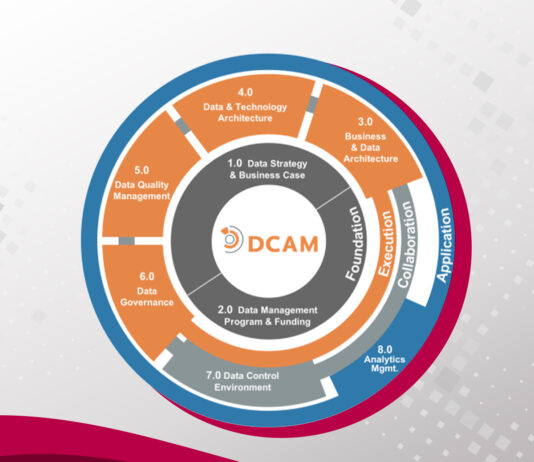
The Data Management Body of Knowledge (DMBOK) and the Data Capability Assessment Model (DCAM) both provide structured approaches to managing data, but with distinct purposes. DMBOK, developed by DAMA International, serves as a comprehensive reference guide outlining best practices across 11 knowledge areas, such as data governance, quality, architecture, and security. It is descriptive, focusing on what organizations should do to manage data effectively, but it does not prescribe a specific implementation roadmap or maturity model. In contrast, DCAM, created by the EDM Council, is a capability-based maturity framework that evaluates how well an organization executes data management through 8 capability domains, including data strategy, governance, quality, and analytics enablement. DCAM provides a structured assessment model, measuring an organization’s data maturity and guiding improvements over time. While DMBOK defines best practices, DCAM focuses on benchmarking and execution, making them complementary tools for organizations looking to both establish and enhance their data management capabilities.
Key documents
Comparing and Contrasting DMBoK Knowledge Areas vs. DCAM Capability Domains
One of the key differences between DMBoK and DCAM lies in how they structure data management disciplines. DMBoK is organized into knowledge areas, which describe what needs to be done in data management, while DCAM is structured around capability domains, which focus on how well an organization executes data management in a measurable way.
DMBoK Knowledge Areas
DMBoK defines 11 knowledge areas, each representing a critical discipline in data management. These knowledge areas provide best practices, roles, and responsibilities but do not prescribe an implementation roadmap.
- Purpose: Acts as a reference framework for data professionals
- Structure: Covers all aspects of data management from governance to quality, architecture, and security
- Scope: Focuses on fundamental data principles and best practices but does not include a built-in maturity assessment
- Implementation: Organizations must interpret and apply DMBoK based on their specific needs
DMBoK’s 11 Knowledge Areas
- Data Governance: Policies, accountability, and stewardship
- Data Architecture: Blueprints for managing data assets
- Data Modeling & Design: Structuring data for business use
- Data Storage & Operations: Managing databases, warehouses, and data lakes
- Data Security: Protecting data from risks and breaches
- Data Integration & Interoperability: Connecting data across systems
- Master & Reference Data Management: Ensuring a single source of truth
- Metadata Management: Managing definitions, lineage, and classification
- Data Quality: Ensuring accurate, complete, and reliable data
- Business Intelligence & Analytics: Using data for insights and reporting
- Big Data & Data Science: Managing AI, ML, and large-scale data analytics
DCAM Capability Domains
DCAM, in contrast, is built around capability domains that help organizations assess, measure, and improve their ability to manage data effectively. Instead of describing individual disciplines, DCAM evaluates the maturity of key data capabilities and provides a structured roadmap for improvement.
- Purpose: Serves as a maturity assessment framework for measuring data management effectiveness
- Structure: Divides data management into eight capability domains, each with specific maturity levels
- Scope: Focuses on how well an organization executes data management rather than just what should be done
- Implementation: Provides a benchmarking model that organizations can use to evaluate and improve their data practices
DCAM’s 8 Capability Domains
- Data Strategy: Aligning data management with business priorities
- Data Governance: Establishing stewardship, accountability, and controls
- Data Architecture: Creating a scalable and efficient data environment
- Data Quality Management: Implementing controls to ensure trusted data
- Data Operations & Integration: Enabling seamless data flow and usability
- Analytics & AI Enablement: Supporting advanced insights and machine learning
- Data Risk & Security: Managing compliance, security, and risk mitigation
- Technology & Platform Enablement: Selecting and optimizing data technologies
Key Differences: DMBoK Knowledge Areas vs. DCAM Capability Domains
| Comparison Factor | DMBOK Knowledge Areas | DCAM Capability Domains |
| Purpose | Defines best practices for each data discipline | Assesses and improves an organization’s data management maturity |
| Structure | 11 knowledge areas, each covering a core discipline | 8 capability domains, each measuring execution and maturity |
| Focus | Covers what needs to be done in data management | Evaluates how well data is managed using maturity levels |
| Implementation | Provides general guidance but lacks a built-in maturity model | Includes a structured assessment tool for benchmarking data capabilities |
| Measurement | No built-in scoring system | Uses a maturity model (e.g., Ad Hoc → Optimized) |
| Usability | Best for organizations building a data management framework | Best for organizations assessing and improving existing capabilities |
Key Similarities
Despite their differences, DMBoK and DCAM are complementary in many ways:
- Comprehensive Data Management Coverage: Both frameworks address governance, architecture, quality, security, and analytics
- Business Alignment: Both emphasize the need for data to support business objectives
- Governance as a Foundation: Data governance is central in both models
When to Use DMBoK vs. DCAM?
- Use DMBoK when building a structured data management function or developing best practices
- Use DCAM when assessing data maturity, benchmarking capabilities, and
creating an improvement roadmap - Use Both Together to define best practices (DMBoK) and measure organizational progress (DCAM)