

Beyond Certifications: Understanding the DMBOK and DCAM Divide (Part II)
Both DMBoK and DCAM emphasize the importance of documentation and artifacts as part of a structured data management approach. However, they differ in purpose, level of detail, and how they are used.
Business Driver Alignment
- Both DMBoK and DCAM align with key business drivers that push organizations to manage data effectively. One of the most critical drivers is regulatory compliance, as industries face increasing requirements from laws like GDPR, CCPA, and BCBS 239.
- DMBoK provides best practices for ensuring data security, governance, and quality, while DCAM offers maturity assessments to measure how well these compliance standards are embedded in an organization’s processes. Another major business driver is data-driven decision-making, where companies leverage data for competitive advantage.
- DMBoK lays the foundation by defining principles for data modeling, integration, and analytics, while DCAM ensures that data is trusted, well-managed, and strategically aligned with business goals. Additionally, the need for operational efficiency and cost reduction drives companies to optimize data architectures and processes.
- DMBoK describes how to structure and govern data assets, whereas DCAM measures how efficiently these data assets support business operations. Both frameworks also emphasize data as a business asset, aligning with corporate strategies that seek to maximize the value of data investments.
- Ultimately, while DMBoK provides guidance on best practices, DCAM ensures that these principles are effectively implemented and continuously improved, making them complementary tools for businesses aiming to leverage data for compliance, efficiency, and strategic advantage.
Comparing DMBoK Artifacts and DCAM Assessment Deliverables
Both DMBoK and DCAM emphasize the importance of documentation and artifacts as part of a structured data management approach. However, they differ in purpose, level of detail, and how they are used. DMBoK artifacts serve as reference documentation for implementing best practices, while DCAM artifacts are deliverables used as proof of maturity and capability assessment.

DMBoK outlines various documentation types that organizations should maintain for effective data management. These artifacts serve as blueprints, policies, and guidelines that define data processes, responsibilities, and structures. Key examples include:
- Data Governance Policies – Rules governing data ownership, stewardship, and accountability
- Data Management Strategy – A document outlining objectives, guiding principles, and execution plans
- Data Models (Conceptual, Logical, Physical) – Blueprints defining how data is structured for different use cases
- Metadata Repository & Data Dictionary – Documentation of business terms, data definitions, and lineage
- Data Quality Standards & Rules – Defined criteria for accuracy, completeness, consistency, and reliability
- Data Integration Specifications – Technical documents defining data flows, ETL processes, and interoperability
Purpose of DMBoK Artifacts
- Define best practices and structures for long-term data governance
- Serve as guidelines for implementing data management processes
- Support regulatory compliance by establishing documentation standards

DCAM, as a capability assessment model, requires tangible proof of implementation to validate an organization’s data maturity. These deliverables are auditable artifacts that demonstrate the real-world execution of data management practices. Key examples include:
- Enterprise Data Strategy Document: A living document proving alignment between data management and business goals
- Governance Framework & Stewardship Model: Evidence of governance structures, roles, and accountability mechanisms
- Data Quality Measurement Reports: Metrics and KPIs showing how data quality is monitored and improved
- Data Architecture Documentation: Proof of architectural design, platforms, and governance of data ecosystems
- Metadata and Lineage Reports: Reports generated from metadata management tools to track data lineage
- – Regulatory Compliance Audit Reports: Documentation proving alignment with industry regulations (e.g., GDPR, BCBS 239)
Purpose of DCAM Deliverables
- Provide measurable evidence of data maturity and governance effectiveness
- Align with maturity assessment criteria, showing improvement over time
- Demonstrate operational execution rather than just theoretical best practices
Key Differences: DMBoK vs. DCAM Artifacts
| Aspect |
DMBOK Artifacts (Documentation) |
DCAM Deliverables (Proof of Maturity) |
| Purpose | Defines best practices and knowledge areas | Demonstrates implementation and effectiveness |
| Level of Detail | Broad guidance across multiple domains | 8 capability domains, each measuring execution and maturity |
| Usability | Used as reference documentation for data teams | Used for audits, assessments, and benchmarking |
| Governance Artifacts | Governance policies, stewardship roles | Proof of active data governance implementation |
| Quality & Metadata | Standards and definitions | Measurement reports tracking improvements |
| Strategy & Compliance | High-level frameworks and policies | Regulatory audit reports and compliance tracking |
How DMBoK Artifacts Inform DCAM Deliverables
DMBoK artifacts serve as the foundation for creating the DCAM deliverables required in a data capability assessment. For example:
- A data governance policy (DMBoK) → becomes evidence of governance execution (DCAM)
- A conceptual data model (DMBoK) → supports architecture documentation (DCAM)
- Defined data quality rules (DMBoK) → feed into measurable data quality reports (DCAM)
DMBoK provides the “What,” while DCAM provides the “How” and the “Proof.”
To connect the DMBoK concepts and DCAM concepts, we need to identify shared themes and dependencies between them. The best way to derive associations is by recognizing that DMBoK defines what should be done (best practices) while DCAM measures and enables how well it is done (capability maturity).
Connecting DMBoK and DCAM Concepts
Below is a tabular comparison of DMBoK and DCAM for structured insights and a concept map visualization to show how the frameworks relate across different categories.
Here’s a tabular comparison between the two frameworks:
| DMBoK Concept | Association | Related DCAM Concept |
| Data Governance | “Is assessed by” | Data Governance |
| Data Architecture | “Enables” | Data Architecture |
| Data Quality | “Provides criteria for” | Data Quality Management |
| Master & Reference Data | “Supports” | Data Strategy |
| Data Security | “Aligns with” | Regulatory Compliance |
| Business Intelligence & Analytics | “Contributes to” | Analytics & AI Enablement |
| Big Data & Data Science | “Depends on” | Technology & Platform Enablement |
Here’s a concept map visualization between the two frameworks:
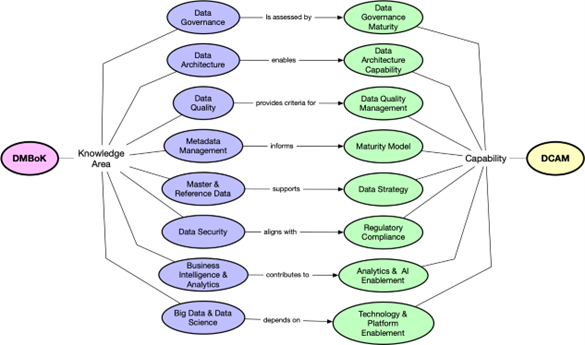
Derived Key Associations
Governance-Driven Connection
- DMBoK’s Data Governance provides a policy framework, while DCAM assesses governance maturity
- Association: “DMBoK defines governance; DCAM measures its effectiveness”
Capability Maturity Connection
- DMBoK outlines best practices for Data Quality, Metadata, and Security, while DCAM provides maturity levels to evaluate how well these practices are implemented
- Association: “DMBoK provides standards; DCAM benchmarks implementation”
Execution and Business Alignment Connection
- DMBoK focuses on structured knowledge, while DCAM ensures it is business-aligned and execution-focused
- Association: “DMBoK describes; DCAM operationalizes”
Comparative Analysis of DMBoK and DCAM Frameworks Summary
Purpose and Focus
| Aspect | DMBOK (DAMA-DMBOK) | DCAM (Data Capability Assessment Model) |
| Primary Purpose | Reference guide for data management best practices | Maturity model for assessing and improving data capabilities |
| Focus | What organizations should do to manage data effectively | How organizations can assess and develop their data capabilities |
| Scope | Comprehensive coverage of all data management disciplines | Focuses on capabilities, emphasizing governance, architecture, and business value |
Structure and Organization
| Aspect | DMBOK | DCAM |
| Core Framework | 11 Knowledge Areas (Data Governance, Quality, Architecture, etc.) | 8 Core Capability Areas with specific sub-capabilities |
| Organizational Focus | Supports data practitioners with best practices and methodologies | Designed for executives (CDOs, CIOs) to evaluate organizational data maturity |
| Implementation Approach | Provides structured knowledge but does not prescribe maturity stages | Includes maturity levels (Ad Hoc → Foundational → Advanced → Optimized) |
Key Components Comparison
| Aspect | DMBOK | DCAM |
| Data Governance | Covered as a core knowledge area | A key domain with specific assessment criteria |
| Data Architecture | Defined in the framework but lacks a roadmap | Includes assessment of architecture maturity |
| Metadata Management | Provides best practices and roles | Evaluates metadata capabilities and maturity |
| Data Quality | Focuses on principles, dimensions, and roles | Assesses the organization’s data quality controls |
| Analytics & AI Readiness | Covers concepts but does not address AI adoption | Explicitly includes AI and analytics enablement |
Practical Application
| Aspect | DMBOK | DCAM |
| Who Uses It? | Data professionals, data stewards, governance teams | CDOs, CIOs, enterprise architects, governance leaders |
| When to Use It? | When building or formalizing data management functions | When assessing maturity and creating a data strategy roadmap |
| Industry Adoption | Widely used in academic and professional certifications (CDMP) | Used by organizations for benchmarking and regulatory alignment (e.g., BCBS 239, GDPR) |
| Regulatory Compliance | Provides general guidance on compliance needs | Aligns closely with regulations and includes compliance assessment tools |
Strengths and Weaknesses
| Aspect | DMBOK Strengths | DMBOK Weaknesses | DCAM Strengths | DCAM Weaknesses |
| Depth of Knowledge | Comprehensive data management guidance | No direct implementation roadmap | Clear focus on execution and capabilities | Less detailed on underlying data management disciplines |
| Usability | Provides structured reference materials | Requires adaptation to real-world use cases | Provides structured assessment with benchmarks | Requires expertise to implement effectively |
| Industry Alignment | Aligns with traditional data management practices | Not tailored for AI and analytics-driven environments | Well-aligned with modern data governance and AI | More prescriptive, which may not fit all organizations |